

Sales Comparison Approach to Farmland Appraisal: Why Market Evidence Matters
Originally published by Iowa State University. Co-authored by Rabail Chandio and Emily Oberbroeckling.
This article is the third in a three-part series examining the primary methods used to appraise farmland in Iowa and across the Midwest. The first article explored the income approach and how earning power, capitalization rates, and discounting future cash flows help explain farmland values. The second article focused on the cost approach to separating the land value from improvement value and measuring how construction costs and depreciation influence overall market value.
The sales comparison approach is the most visible and widely understood method of property valuation. In fact, many people use a simplified version of it when looking at homes: comparing similar properties in the area that have recently sold. The same idea can apply to farmland in areas where similar types of farms have sold. The discovery of 'value' in basic terms is revealed through transactions between buyers and sellers based on market evidence rather than purely on replacement cost or a single income metric. The central questions are: What are similar properties selling for, given this defined market area and time frame? And what quantitative and qualitative metrics are being used in the market to estimate the value of farmland?
The sales comparison approach estimates value by examining what similar properties have recently sold for in the subject property's market. It is grounded in the principle of substitution, which holds that a buyer will not pay more for a property than the cost of purchasing a comparable alternative with similar characteristics. According to The Appraisal of Real Estate (15th ed.), The value of a property tends to be set by the price that would be paid to acquire a substitute property of similar utility and desirability within a reasonable amount of time. This principle implies that the reliability of the sales comparison approach is diminished when substitute properties are unavailable in the market.
Appraisers apply this method by analyzing recent comparable sales (often called "comps") and applying market-derived adjustments for relevant factors, which can sometimes be derived from these and other sales. The sales data is compared to the subject based on the following elements of comparison: real property rights conveyed, financing terms, conditions of sale, expenditures made immediately after purchase, and market conditions. Location and other physical characteristics are then considered. Physical characteristics typically used for comparison include legal and physical access, annual precipitation or water rights, property or field shape, topography, utilities, zoning, soil characteristics or ratings (CSR2 in Iowa), crop yield history, ease of farm-to-market access, and flood zones. Because adjustments for these relevant factors are market-derived, the desires and actions of typical buyers and sellers are reflected in the comparison process.
The approach is especially useful for properties with similar characteristics and that are bought and sold frequently in a defined market area(s), such as Iowa, including farmland. Because it relies directly on observed market transactions, the sales comparison approach often carries significant weight in farmland appraisals, particularly when reliable, recent comparable sales data is available.
To analyze agricultural land, market participants view a property in regard to its potential agricultural uses and production. This includes how many acres are available for production and what type of agricultural production is best suited for those acres. Buyers of agricultural land often determine a value for each land type that might be included on a property. Areas of a property that are not suitable for agricultural production such as timber, ditches, and right of way are typically less valuable. The industry recognized method used by professional agricultural appraisers utilizes the land use mix analysis or Equivalent Acres and Equivalency Ratio % (ER Factor) to accomplish this type of review.
Steps in the Sales Comparison Approach
Define the subject property
Identify the real estate or farmland being appraised, including its physical, legal, and economic characteristics.Research the market
Determine the relevant market area and identify recent sales, listings, pending sales, and other transactional market data.Select the most comparable sales
Choose properties that compete with the subject and reflect similar utility, desirability, and market appeal.Verify the data
Confirm sale prices, terms, conditions of sale, motivations of the parties, and property characteristics.Choose the appropriate unit of comparison
Examples include: price per acre, price per tillable acre, price per square foot, or price per equivalent acre.Compare each sale to the subject
Develop a comparative analysis using the elements of comparison for each and analyze similarities and differences between each comparable sale and the subject property.Adjust for differences
Make market-supported adjustments for factors such as:property rights conveyed
financing terms
conditions of sale
expenditures made after purchase
market conditions (time)
location
physical characteristics
soil ratings
(Corn Suitability Rating, CSR2 Iowa)topography/utility/flood zone
physical access/road frontage/legal access
size of farm or acreage
economic characteristics
building improvement contribution
use or zoning
Apply qualitative and/or quantitative analysis
Use extracted adjustments, paired sales, percentages, dollar adjustments, or the overall ranking of comparables (superior, inferior, similar).Reconcile the adjusted sale indications
Weigh the comparables based on relevance and reliability.Develop a final value conclusion
Arrive at an opinion of value for the subject property based on the credible market evidence.
Appraisers rarely rely on a single sale. Instead, they look for patterns across multiple transactions. The final value conclusion reflects: (i) The most comparable sale(s); (ii) the most reliable data, and (iii) overall market trends.
Example: applying the sales comparison approach
Suppose an appraiser is estimating the value of an 80-acre farm in Linn County, Iowa with a CSR2 soil rating of 82 and approximately 95% tillable acres. The appraiser identifies three recent sales of farms with broadly similar characteristics in the surrounding area.
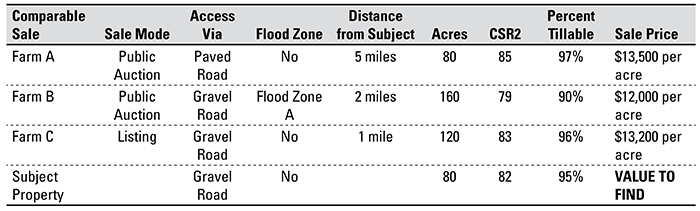
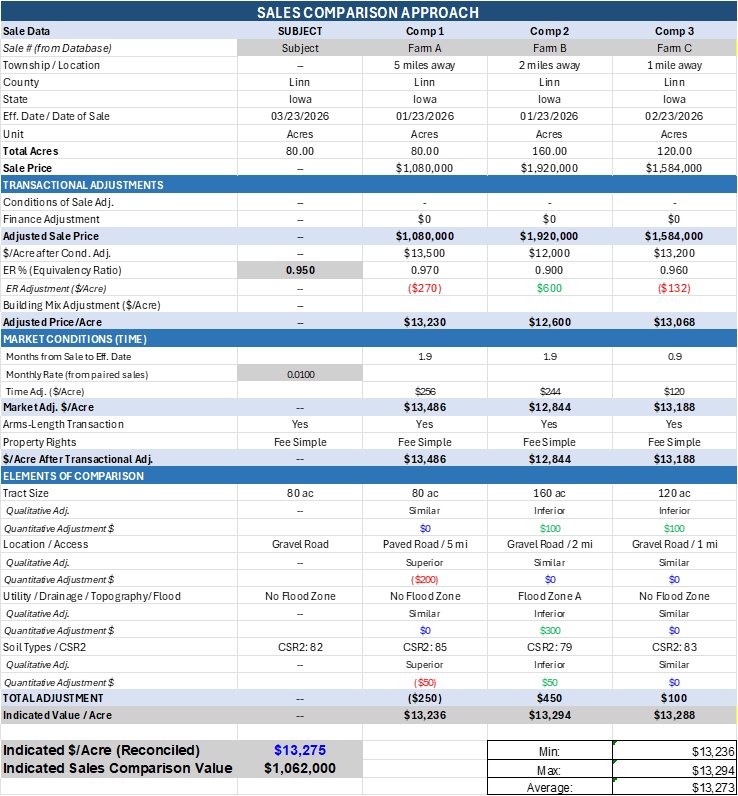
Through the sales comparison process, as shown, both quantitative and qualitative adjustments are demonstrated. There is a particular order for operation, in which the transactional and market (time) adjustments are made before the other elements of comparison. If the comp is superior to the subject, a negative adjustment is shown; if the comp is inferior to the subject, a positive adjustment is shown. This is merely an example, and the market-indicated factors and the adjustments are assumed to have been calculated outside the table shown.
Strengths and limitations of the sales comparison approach
The primary strength of the sales comparison approach is that it reflects actual market behavior. Because it relies on real transactions between buyers and sellers, it often provides the most direct evidence of value when sufficient sales data are available. However, the approach also has limitations. In areas with limited land sales, finding truly comparable properties can be challenging, limiting the ability to take an objective, calculated approach. Some transactions may also reflect unique circumstances, such as family transfers, strategic expansion by neighboring operators, or tax considerations that do not fully represent typical market conditions.
How the three approaches work together
Overall, the three approaches to appraisal provide a comprehensive view of farmland value. The income approach focuses on what the land can earn, the cost approach examines what it would cost to build or replace the property, and the sales comparison approach reflects what similar properties are selling for in the marketplace. Appraisers typically consider all three perspectives and reconcile the results to arrive at a final opinion of value. Understanding how these approaches work helps landowners, producers, lenders, and investors interpret farmland markets more clearly. While individual sales provide snapshots of market activity, appraisal methods help explain the broader economic forces that shape land values across Iowa and the Midwest.
Agriculture
Crop Insurance
Energy Management
Growing Together
Industry Insights
Land Auctions
Land Management
Land Values
News & Events
Real Estate



Peoples Company proactively works to anticipate the needs of those in the agricultural sector. Our monthly email publication keeps readers in the know about everything land.
