

Rethinking Institutional Farmland Valuation: From Snapshot to Ongoing Insight
Institutional real estate valuations have historically been treated as snapshots, a periodic compliance exercise: a report delivered, a value recorded, and a box checked until the next cycle. But this approach underestimates what an independent relationship between an institutional investment group and a qualified agricultural appraiser can and should be. When properly positioned, agricultural appraisers can serve as trusted resources, helping institutional investment groups foresee potential shifts in property values, better meet their fiduciary obligations to investors, and maintain investor confidence.
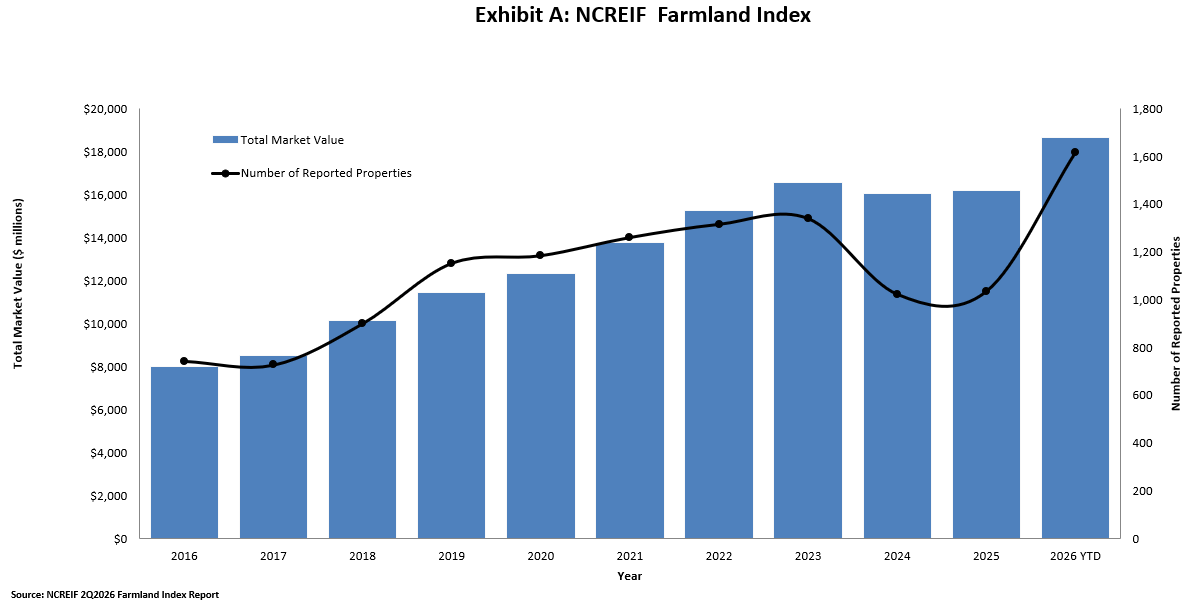
Institutional capital represented in the NCREIF Farmland Index has grown substantially over the past decade. As shown in Exhibit A, the total market value in the NCREIF Farmland Index universe more than doubled over the period, from roughly $8.0 billion to nearly $18.7 billion, and the number of contributing properties grew alongside it. An index of that scale, and with that much investor capital behind it, depends on valuation practices that keep pace.
Appraiser Independence Remains the Foundation
Any discussion of an appraiser’s role must be grounded in independence. The Uniform Standards of Professional Appraisal Practice (USPAP) establishes objectivity and impartiality as the appraiser’s core ethical obligations. Those duties are owed not just to the engaging client but to the public, ensuring trust in the valuation profession.
This is especially true in institutional contexts, where clients often retain meaningful latitude in how portfolio assets are marked and valuation discretion carries real financial implications. Investor confidence is paramount for capital partners, and the appraiser’s ongoing role in monitoring value is central to sustaining it. Therefore, independent third-party valuations can serve an important compliance or governance role by strengthening investor confidence and supporting the credibility of reported values.
Independence and objectivity are not in conflict with being a genuine, ongoing resource. An appraiser can maintain full autonomy and independence over their work product while still serving a role in identifying market dynamics and emerging risk more clearly. The two roles are not necessarily in tension. However, appraisers must not create an expectation of continuity in value conclusions. The goal is continuity of market knowledge, so each valuation must independently reexamine assumptions against current property and market realities.
A Case for Ongoing Engagement
The value of an experienced appraiser extends well beyond the delivery of a single valuation. It rests on continuity. An appraiser who understands a property or portfolio’s history can proactively research and analyze relevant market activity, can better quantify dynamic economic variables like crop pricing, labor, and inflation, and can track a property’s sale process to better quantify the price ceilings and marketing times.
The relationship between appraiser and institutional client should not be seen as a series of disconnected engagements but as an ongoing engagement, one that improves the quality of the valuation itself and strengthens visibility into the market dynamics shaping an agricultural investment.
An ongoing engagement does not mean that every market observation constitutes a new appraisal. Formal valuation assignments remain tied to defined dates and requirements. However, between those assignments, an appraiser may monitor relevant transactions, economic changes, and property dynamics without issuing an updated opinion of value. In keeping with the appraiser’s responsibility to maintain independence, broader portfolio or disposition advice, if provided, should be clearly distinguished from the independent appraisal function.
Timing tied to the asset, not the calendar. The timing of institutional investment valuation has historically followed quarterly or annual financial deadlines. However, to provide more meaningful information, valuations may be better aligned with crop and operational milestones, such as pre- or post-harvest points, crop production announcements, or asset life-cycle milestones. These key milestones serve as ideal times for appraisers to complete a more comprehensive analysis and have boots on the ground. Between these milestones, additional reports or client communications can help keep clients apprised of asset values, as appropriate. Importantly, more frequent updates may not indicate a change in value, but they keep clients and their capital partners current on market dynamics and comparable or competitive property activity.
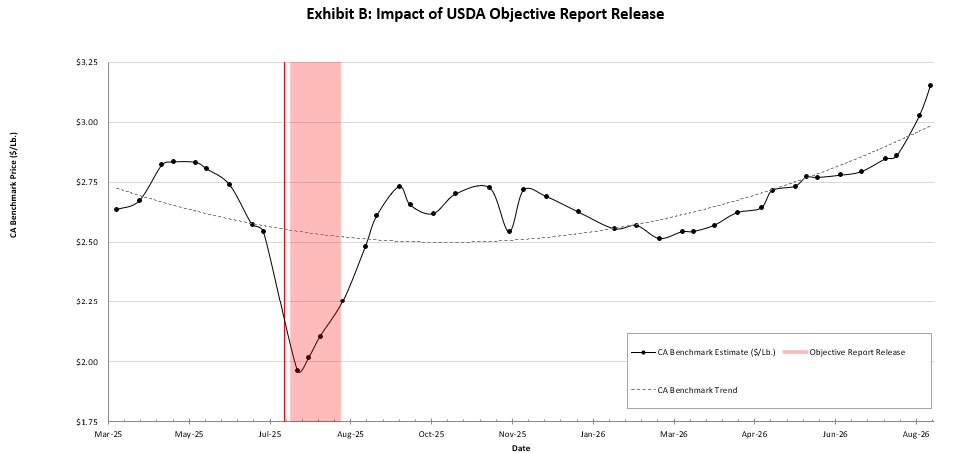
Continuous monitoring of shifting inputs. Well-managed institutional-grade farmland with a strong production history is not always representative of the properties transacting in a given market cycle. An appraiser with ongoing visibility into a portfolio and its markets is better equipped to identify and rely on truly comparable data points, rather than being anchored to transactions that do not reflect the actual property class. Commodity price shifts, weather events, global economic changes, and other influential events do not move on a financial calendar. An appraiser who is continuously tracking these inputs is positioned to weigh a given year’s price movement against long-term historical trends and volatility, rather than treating each new data point in isolation. A brief change, such as a short-term price spike or dip, can produce a noticeable swing in a single valuation if that valuation happens to fall inside the window. As shown in Exhibit B, the 2025 USDA Objective Almond Measurement Report estimated a 3-billion-pound crop, although many had forecasted a lighter crop, sending prices notably lower for several weeks. For assets that are infrequently valued, market shifts like this can be misleading; however, a more continuously monitored asset can quickly illustrate the scale and impact of market changes.
Exit-timing awareness. Institutional fund structures can have unique timelines that do not align with agricultural cycles, commodity swings, orchard and vineyard replanting schedules, or shifts in water availability. Continuous dialogue between the appraiser and the institutional investment manager allows emerging headwinds to be flagged well before a liquidity event and can better prepare clients and their capital partners alike.
Permanent Plantings: Physical Aging and Economic Life Are Not the Same Thing
Permanent planting assets can carry an additional layer of complexity as the trees and vines themselves age and depreciate independently of other market variables. Ongoing appraisal engagements help clients better distinguish value changes driven by external market conditions from those driven by ordinary physical aging. Without that continuity, the two can easily be conflated.
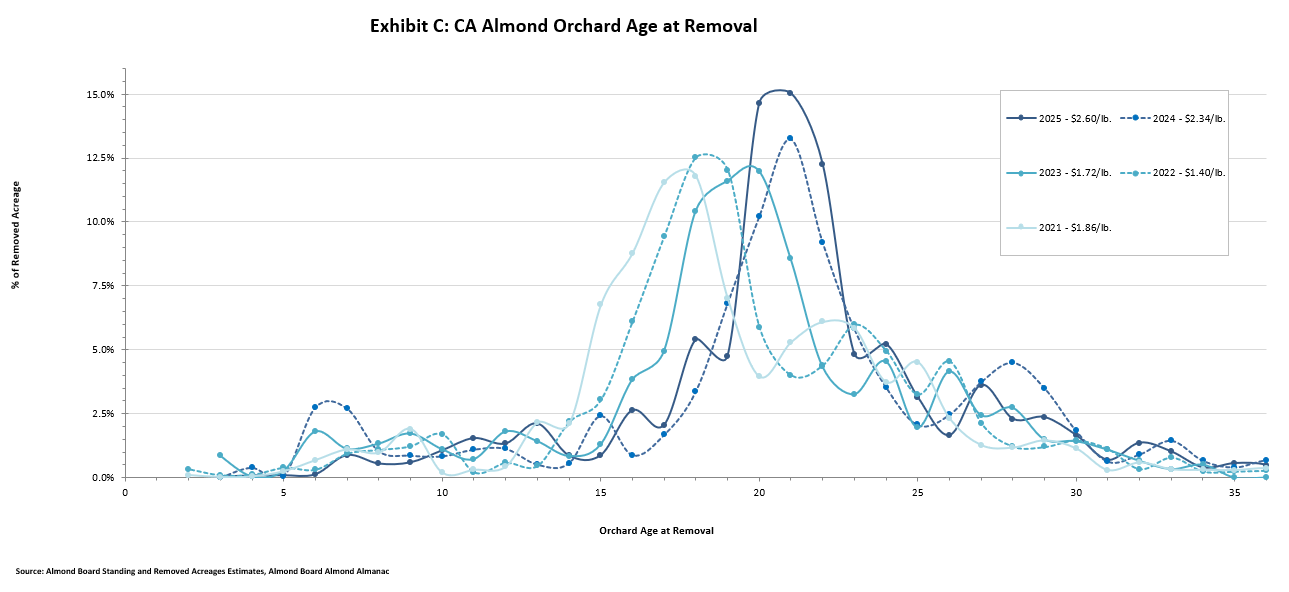
Physical aging, though, is only part of depreciation. A permanent planting’s economic life, the period in which it remains a productive, value-generating asset, can diverge meaningfully from its physical life. Varietal demand shifts, changes in commodity pricing, and cost inflation can all shorten or extend the life of permanent plantings. Exhibit C illustrates how the average California almond orchard lifespan (orchard age at time of removal) has increased as average almond pricing has recovered in recent years. An appraiser with ongoing insight into a property is positioned to help clients better anticipate these economic-life impacts.
Conclusion
Institutional farmland valuation is changing. As clients navigate dynamic markets, more efficient dashboard reporting, interactive sensitivity analyses focused on key variables, notifications tied to changing market conditions, and other new tools are likely to become more common. Appraisers can help identify emerging risks between formal assignments while maintaining a relationship grounded in independence. The timing of valuations should reflect not only financial reporting requirements, but also crop cycles, property life cycles, and significant operating or market events.
Overall, ongoing communication between appraisers and their clients gives institutional investment managers sharper context and better valuations.
Jeremy Darner is a Managing Partner for Peoples Company’s Pacific West office. The Pacific West office provides brokerage, appraisal, and consulting services across the major farming areas in the region. For more information, please contact Jeremy at [email protected].
Agriculture
Crop Insurance
Energy Management
Growing Together
Industry Insights
Land Auctions
Land Management
Land Values
News & Events
Real Estate

Peoples Company proactively works to anticipate the needs of those in the agricultural sector. Our monthly email publication keeps readers in the know about everything land.
