

Advantages and Disadvantages of No-Till Farming Practices
No-till farming is a technique for growing crops without disturbing the soil through plowing or tilling. Instead of turning over the soil like conventional farming methods, specialized equipment is used to create furrows, plant seeds, and cover them. This specialized equipment also allows for the application of fertilizer directly into the furrow, resulting in minimal fertilizer waste. Over the past several decades, no-till farming has gained attention as a more sustainable alternative to conventional tillage.
No-till farming has a number of advantages over conventional farming practices that we will look at below.
Reduced Soil Erosion
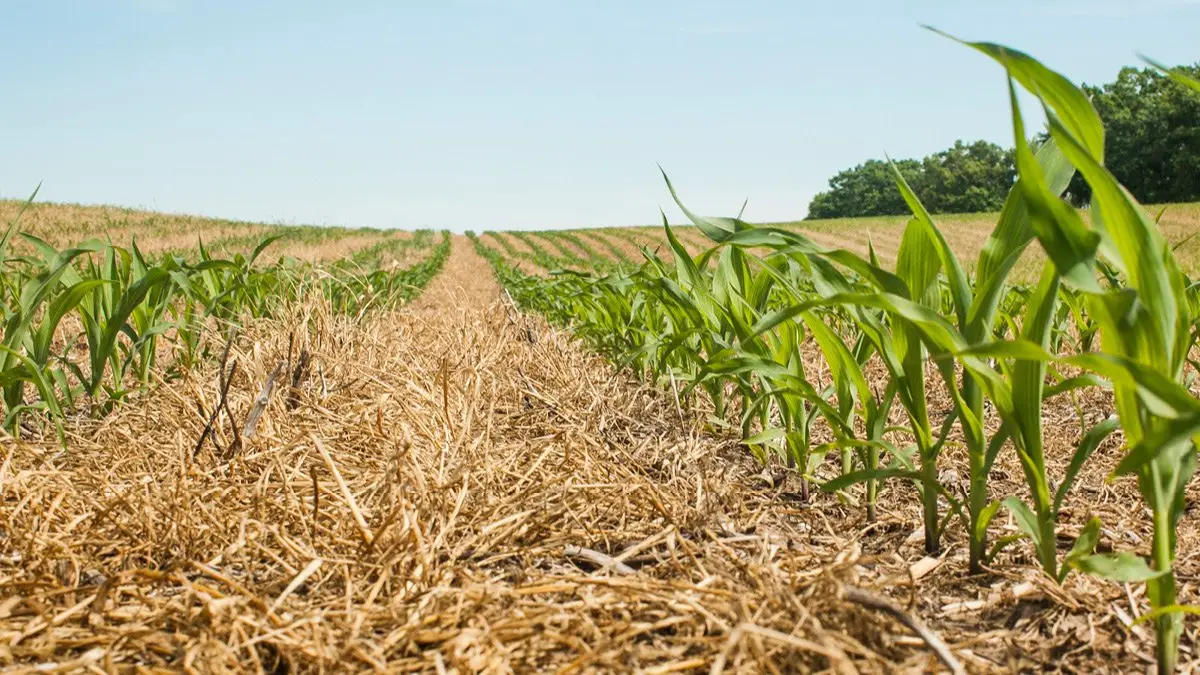
One of the main advantages of no-till farming is reduced soil erosion. When soil is left undisturbed and covered with crop residue or cover crops, it is less vulnerable to being washed or blown away by wind and water. With conventional farming methods, the top six to ten inches of soil are turned over, leading to significant exposure. Loose topsoil with no crop residue is much easier to wash or blow away with heavy rainfall or high winds. By preventing erosion, no-till farming helps maintain your topsoil, which is essential for crop production.
Soil Health
No-till farming has positive impacts on soil health. Traditional tillage disrupts soil structure, breaking apart aggregates that help with retaining water and nutrients. No-till farming preserves these structures, allowing soil to maintain its natural composition. Over time, this leads to increased organic matter, healthier soil organisms and microbes, and better nutrient cycling.
Organic Matter and Water Retention
Crop residue from no-till farming creates a layer of organic matter that helps protect from drought conditions and promotes healthier soils. Residue reduces evaporation, cools the soil, and improves soil moisture levels, which is critical during periods of limited rainfall. Improved water retention means crops are more resilient during drought conditions, reducing irrigation needs and ultimately lowering water usage and costs.
Cover crops may also help with organic matter and water retention. Cover crops help dry out wet soil faster in the spring, allowing for earlier planting. The roots of cover crops help with breaking up soil compaction and can double as a high-quality forage for grazing livestock. Cover crops also add to the organic matter in soil, helping to cool the soil and improve moisture levels.
Cost Savings for Producers
No-till farming practices offer economic benefits in addition to environmental benefits. Because farmers eliminate plowing and tillage, they save on fuel, labor, and equipment wear and tear. This is especially important in today’s world of high input costs. For example, the USDA states that conventional tillage farming uses over six gallons of diesel fuel per acre each year, whereas no-till farming practices require less than two gallons of diesel fuel per acre each year. A producer farming 1,000 acres of ground at today’s cost of $5.00 per gallon of diesel will spend $30,000 in fuel for conventional farming practices compared to $10,000 in diesel cost for no-till farming. Fewer passes over the field mean lower operational costs, lower labor costs, and lower equipment repair costs, making no-till farming an attractive option for profitability.
Improved Long-Term Yields
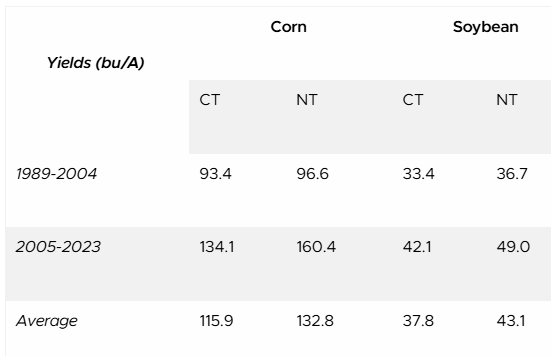
In 2025, Michigan State University published the results of a 30-year-long study comparing no-till plots to conventionally tilled plots. For the first 15 years of research, no-till plots had comparable yields to the conventionally tilled plots across both corn and soybeans. Shown in the table below, the study highlights that no-till farms have outyielded conventionally tilled plots in both corn and soybeans most consistently after 15 years of practice.
Despite these advantages, no-till farming has its drawbacks.
Weed Control
One of the primary challenges of no-till farming is weed management. Without tillage to disrupt weed growth, farmers often rely more heavily on herbicides for weed control. This can increase input costs and raise environmental concerns regarding chemical runoff and herbicide-resistant weeds. Poor weed management decreases yields and hurts farm profitability.
Slower Soil Warming
Crop residue can cause slower soil warming in the spring by insulating the soil and causing higher moisture levels during key planting windows. In the spring, wet soil can cause residue that is difficult to cut, sidewall compaction, and increased prevalence of soil diseases. This can also postpone planting dates and affect early crop growth.
Carryover Crop Diseases
Crop diseases can overwinter in residue, allowing them to survive between growing seasons. Producers must carefully monitor their fields to mitigate this risk and highlight the importance of annual crop rotation.
Specialized Equipment
One of the largest disadvantages of no-till farming is the investment needed in specialized equipment. Equipment modifications or investments into specialized planters are required, which adds to the upfront cost. Planters used for no-till farming require more pressure than traditional planters, as the ground is harder and covered in crop residue. More downward force is required to penetrate the soil and residue. One low-cost modification that can be used is adding weight to the planter, such as iron weights or water drums. No-till farming also requires more residue moving and cutting to reach the soil. Row cleaners are often used to move residue and accelerate soil warming in the springtime. Coulters can also be used to cut residue and break up the soil within the seed trench. Newer planters have a stronger downforce, which may negate the use of coulters. Disk openers are also required for no-till planters. Disk openers are angled metal disks on the planter used to create a “V” in the soil, into which seed is dropped into. The most commonly used are double disk openers.
Conclusion
Like any agricultural practice, the success of no-till farming methods depend on proper management, local soil conditions, and the willingness of producers to adapt to new techniques. By weighing the advantages and disadvantages, producers can make informed decisions about whether no-till farming is the correct choice for the farming operation. Sustainable land practices are a core principle in Peoples Company’s land management approach. If you are a landowner interested in hearing more about no-till farming practices, or sustainable farming practices in general, I encourage you to visit our service page or contact us at [email protected].
Agriculture
Crop Insurance
Energy Management
Growing Together
Industry Insights
Land Auctions
Land Management
Land Values
News & Events
Real Estate

Peoples Company proactively works to anticipate the needs of those in the agricultural sector. Our monthly email publication keeps readers in the know about everything land.
