For farmland owners who lease their land on a cash rent basis, there are limits to how much influence they have over day-to-day farming decisions. Unless specifically addressed in the lease, the tenant generally determines how the farm is operated, including crop rotations, tillage practices, and so on. However, landowners still have opportunities to make a positive impact on their property. Edge-of-field conservation practices offer a way to improve water quality, reduce soil erosion, and enhance wildlife habitat while maintaining the farm’s primary purpose as productive agricultural land. These improvements can be initiated by the landowner and provide environmental benefits for years to come without requiring major changes to the tenant’s farming practices.
The two most straightforward options are prairie strips and buffer strips along waterways. These practices require less infrastructure than engineered drainage systems and can often be established by converting select areas of cropland into perennial vegetation.
Prairie strips use diverse native grasses and wildflowers planted along field contours or field edges to slow runoff and reduce soil and nutrient losses.
Riparian buffer strips serve a similar purpose along streams and waterways, filtering surface runoff before it reaches the water.
By slowing runoff and trapping sediment, prairie strips and buffer strips can reduce phosphorus losses. Research conducted in Iowa indicates that strategically placing prairie strips on approximately 10% of a crop field can reduce nitrogen and phosphorus losses in surface runoff by roughly 85% to 90%. Both practices can also provide valuable wildlife and pollinator habitat. Although they do remove some acreage from crop production, they can be strategically located in areas that are difficult to farm efficiently or particularly susceptible to erosion.
Financial assistance may be available through the Conservation Reserve Program (CRP) and other state or local conservation initiatives. CRP offers eligible landowners annual payments and cost-share assistance for establishing and maintaining conservation practices, including prairie strips and buffer strips. Enrolled acres must meet program standards, comply with use restrictions, and remain under contract for a specified period, typically 10 to 15 years. Because eligibility, funding, and contract terms vary, landowners should consult their local Farm Service Agency (FSA) office to explore available options.
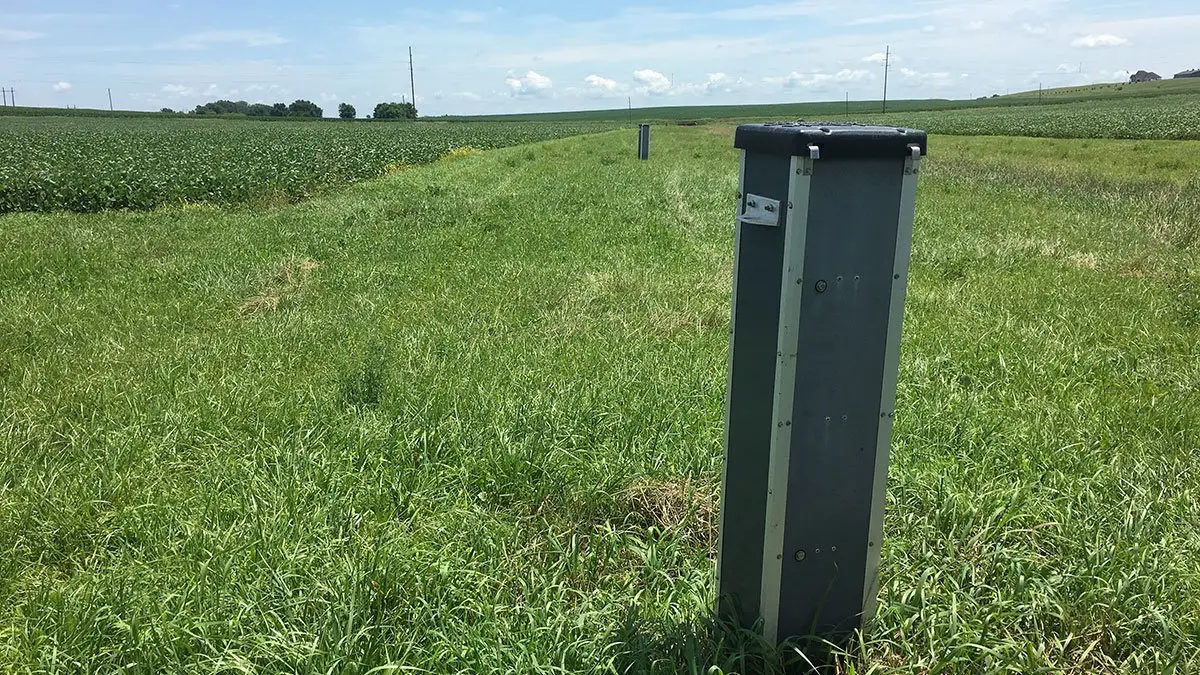
For farms with existing drainage tile, bioreactors and saturated buffers provide a more technical approach to reducing nutrient losses.
A bioreactor consists of an underground trench filled with woodchips that receives water diverted from a tile outlet. The woodchips provide a carbon source for microorganisms that convert nitrates in the water into nitrogen gas through a process called denitrification.
A saturated buffer uses a control structure to divert a portion of tile drainage into a perforated distribution pipe installed parallel to a nearby creek or drainage ditch, beneath an adjacent vegetated buffer. The water disperses laterally through the soil, where microorganisms use available carbon to convert nitrates into nitrogen gas before the water reaches a nearby stream.
Both systems require suitable drainage infrastructure, site conditions, engineering, and ongoing maintenance. Their effectiveness depends on several factors, but research indicates that bioreactors can reduce nitrate concentrations in treated water by roughly 24%, while saturated buffers can achieve reductions of approximately 45%.
Federal and state conservation programs may provide financial assistance for installing bioreactors and saturated buffers, potentially making these practices more financially viable for farmland owners. In Iowa, for example, the Iowa Department of Agriculture and Land Stewardship (IDALS) administers the Batch and Build program, which coordinates multiple projects within a watershed to streamline engineering and construction. This program may cover up to 100% of installation costs. Participating landowners are generally required to enter into maintenance agreements and provide access for installation and inspection. Again, landowners should contact their local Soil and Water Conservation District or appropriate state agency to explore available funding and determine whether their farm is a suitable candidate for these practices.
Conservation opportunities are always worth considering as part of a broader land management strategy. The right practice, combined with available funding opportunities, can help landowners address water quality concerns while making thoughtful, long-term improvements to their property. Evaluating these opportunities requires consideration of the property's characteristics, the landowner's objectives, and available funding. Working with a knowledgeable land manager can help identify opportunities that align with the owner's goals while maintaining the property's long-term value. Landowners interested in learning more about Peoples Company's land management services are encouraged to visit PeoplesCompany.com or contact us at [email protected].